Lost time injury (LTI): Trip incident during routine task
- Safety Flash
- Published on 7 August 2014
- Generated on 27 October 2026
- IMCA SF 14/14
- 3 minute read
A member reported an incident which someone tripped over, fell and was injured whilst working on the deck of a vessel.
What happened?
The incident occurred during work on the rear skid of the backfill plough on the starboard side of the vessel. The injured person required something to kneel on. He proceeded to walk forward on the deck from the aft of the vessel towards the deck skip. He then tripped over a 20Te pad eye, lost his balance and fell over, landing on his right shoulder and arm. The injured person was taken to the vessel hospital; the vessel returned to port to allow the injured person to be transferred to a shore-side hospital for further treatment.
Our member noted that this was the second serious (LTI level) trip incident that had occurred on its vessels in recent weeks, and that there had been an alarming rise in incidents causing injury to personnel engaged in normal ‘routine’ tasks.
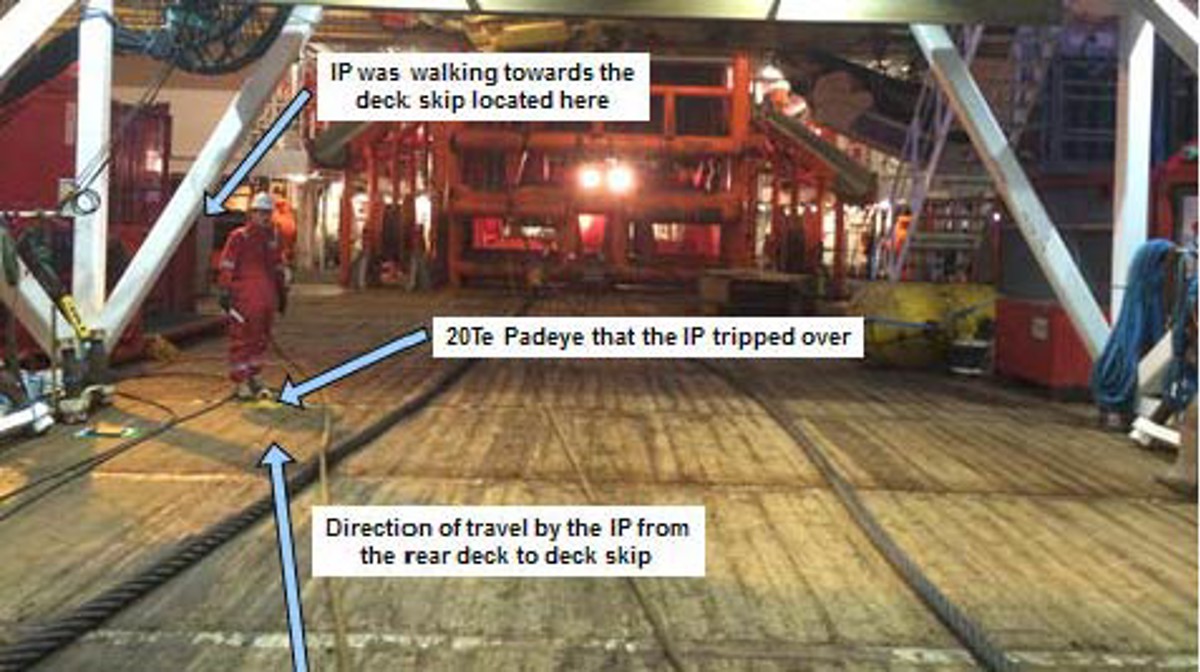
Deck where injured person tripped
Our member’s investigation revealed the following:
- It has been identified that the pad eye was not actually required until the next interim mobilisation, and hence the incident could have been prevented.
- Inadequate planning/risk assessment – without a cordon or other appropriate barriers/markers, this hazard presented an obvious risk, which was not specifically identified. Failure to adequately identify all hazards can result in accidents.
- Inadequate safety controls/warning signs.
- Lack of awareness/perception of risk.
- Lack of attention/due care/poor work practice.
Our member drew the following conclusions:
- In this instance there was a lapse of attention while doing something completely ‘routine’ which had been done many times before, except that this time, the lapse had consequences.
- The key lesson is that we can never be complacent; otherwise, the ever present hazards on our worksites will catch us out.
- It is important that we all take personal responsibility for our own safety and ensure that we do not put ourselves or others ‘in the line of fire’.
- Active supervision and intervention must be at the forefront of our daily activities.
- It is essential that everyone:
- Remains pro-active and maintains a clear focus on hazard identification and accident prevention
- Uses their own ability to be aware of the situation round about them and look where we place our feet and where we put our hands
- The importance of focus on ‘routine’ work’ – where many incidents are occurring.
Related safety flashes
-
IMCA SF 04/09
2 April 2009
IMCA Safety Flashes summarise key safety matters and incidents, allowing lessons to be more easily learnt for the benefit of the entire offshore industry.
The effectiveness of the IMCA Safety Flash system depends on the industry sharing information and so avoiding repeat incidents. Incidents are classified according to IOGP's Life Saving Rules.
All information is anonymised or sanitised, as appropriate, and warnings for graphic content included where possible.
IMCA makes every effort to ensure both the accuracy and reliability of the information shared, but is not be liable for any guidance and/or recommendation and/or statement herein contained.
The information contained in this document does not fulfil or replace any individual's or Member's legal, regulatory or other duties or obligations in respect of their operations. Individuals and Members remain solely responsible for the safe, lawful and proper conduct of their operations.
Share your safety incidents with IMCA online. Sign-up to receive Safety Flashes straight to your email.