Accidental shutdown of main engines
- Safety Flash
- Published on 3 December 2008
- Generated on 28 May 2026
- IMCA SF 17/08
- 2 minute read
A Member has reported an incident in which a vessel’s main engines were inadvertently shut down.
What happened?
During transit, the vessel was rolling considerably and as a result the door of a nearby cabinet swung loose. A member of the marine crew moved to close the door; as he did so the vessel rolled and he was accidentally pressed against the emergency shutdown buttons. The two central buttons controlling the fuel pumps were accidentally activated (see photographs below), causing loss of power to both fuel pumps. The vessel was without main engines for 35 minutes. The generators were unaffected and a thruster was started to provide headway.
It was discovered that the Perspex cover in place to prevent accidental activation was so flexible that it bent in sufficiently to press against and thus activate the emergency stop buttons when the crew member accidentally pressed against it.
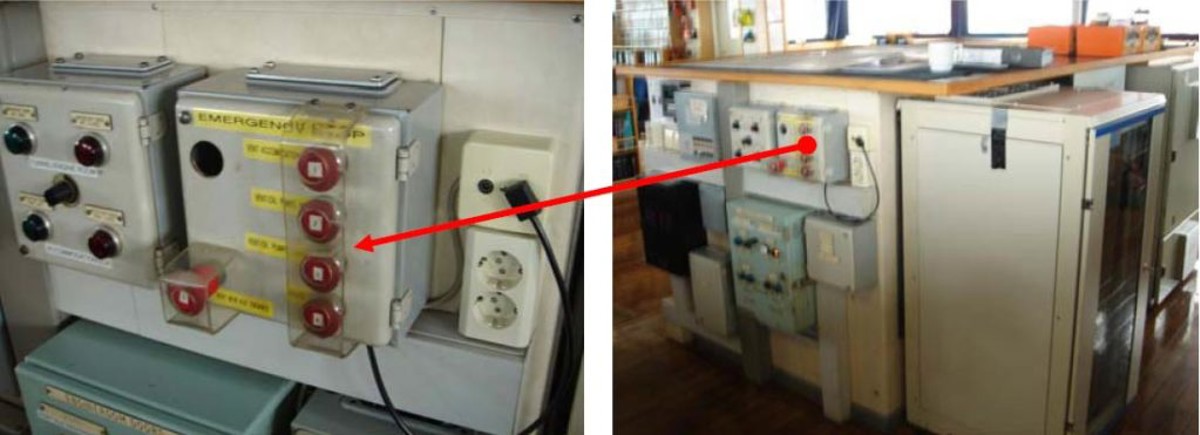
Emergency power switches
The following lessons were learnt:
- It should not be possible to accidentally activate critical items such as emergency shut down controls.
- Protective covers and other barriers to prevent accidental activation must be fit for purpose.
- At least two separate actions should be required to activate the shut down.
- Emergency controls should located in such a way as to be quickly accessible when required but so that accidental activation is not possible.
The following action was implemented immediately to prevent recurrence of this potentially very serious incident:
- The perspex guard was temporarily strengthened and steps were put in place to fabricate and install a permanent guard at the next port call.
IMCA Safety Flashes summarise key safety matters and incidents, allowing lessons to be more easily learnt for the benefit of the entire offshore industry.
The effectiveness of the IMCA Safety Flash system depends on the industry sharing information and so avoiding repeat incidents. Incidents are classified according to IOGP's Life Saving Rules.
All information is anonymised or sanitised, as appropriate, and warnings for graphic content included where possible.
IMCA makes every effort to ensure both the accuracy and reliability of the information shared, but is not be liable for any guidance and/or recommendation and/or statement herein contained.
The information contained in this document does not fulfil or replace any individual's or Member's legal, regulatory or other duties or obligations in respect of their operations. Individuals and Members remain solely responsible for the safe, lawful and proper conduct of their operations.
Share your safety incidents with IMCA online. Sign-up to receive Safety Flashes straight to your email.