MSF: Safety pins left in fire suppression system – high potential near miss
- Safety Flash
- Published on 14 October 2024
- Generated on 26 June 2026
- IMCA SF 20/24
- 2 minute read
The Marine Safety Forum has published Safety Alert 24/07 relating to an incident where a Flag State inspection found that all of the CO2 bottles for the engine room fire suppression system still had their safety pins in place.
What happened?
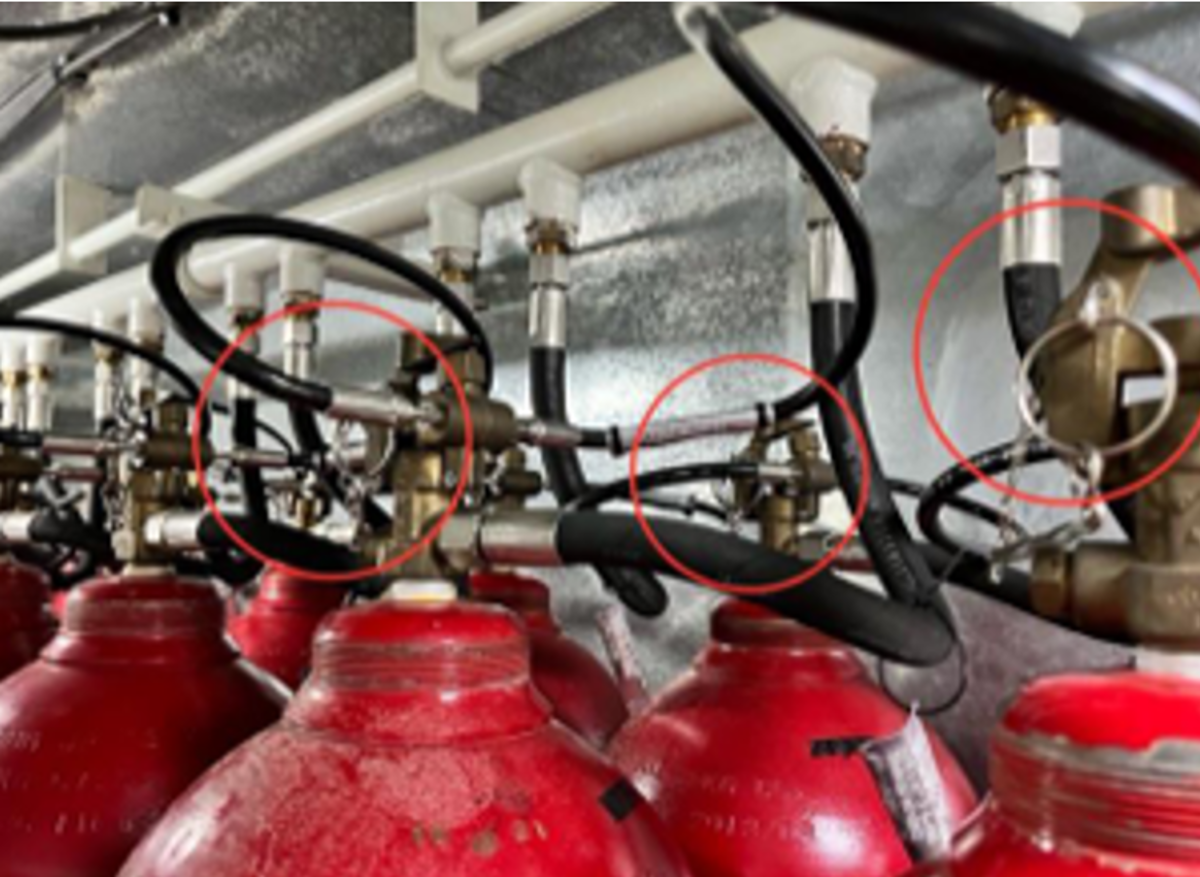
The incident occurred following a major refit / dry docking. The vessel departed port and sailed to its area of operation to complete the works and prepare for being commercially available. On arrival, the Flag State carried out an inspection of the vessel and found that all of the CO2 bottles for the engine room fire suppression system still had their safety pins in place. This means that if there had been an engine room fire, the crew would have been unable to set off the suppression system remotely and any deployment of the system would have been seriously hampered and hindered.
What went wrong?
The safety pins had been put in at the start of the dry dock, as was usual. At the end of the dry dock when the vessel was floated, the fire suppression system was tested by a third party. The safety pins were still in place and the third party left them in situ during testing. After the tests, the third party testing company stated that the system had been put back into service. However, the pins were not removed and were subsequently missed on any pre-sailing or coming out of dry dock checks.
On investigation it was found that the testing work on the system had been carried out without a Permit to Work in place. Had a Permit to Work been in place, the failure to remove the pins would have been picked up during the inspection to recommission the system and close the Permit.
Actions
- Appropriate personnel should be fully familiar with the procedures for operating vessel CO2 fire suppression systems.
- Work on safety critical equipment, including that done by a third party, should be covered under a Permit to Work and should be verified by a deck officer.
- Carry out a check to ensure that safety pins are removed from CO2 fire suppression systems and indeed any other safety critical equipment after dry docking – ensure such equipment is ready for immediate use.
Related Safety Flashes
-
IMCA SF 12/23
16 May 2023
-
-
IMCA SF 04/14
4 April 2014
IMCA Safety Flashes summarise key safety matters and incidents, allowing lessons to be more easily learnt for the benefit of the entire offshore industry.
The effectiveness of the IMCA Safety Flash system depends on the industry sharing information and so avoiding repeat incidents. Incidents are classified according to IOGP's Life Saving Rules.
All information is anonymised or sanitised, as appropriate, and warnings for graphic content included where possible.
IMCA makes every effort to ensure both the accuracy and reliability of the information shared, but is not be liable for any guidance and/or recommendation and/or statement herein contained.
The information contained in this document does not fulfil or replace any individual's or Member's legal, regulatory or other duties or obligations in respect of their operations. Individuals and Members remain solely responsible for the safe, lawful and proper conduct of their operations.
Share your safety incidents with IMCA online. Sign-up to receive Safety Flashes straight to your email.