MSF: Air cylinder – high pressure discharge
- Safety Flash
- Published on 29 August 2023
- Generated on 25 October 2026
- IMCA SF 21/23
- 2 minute read
The Marine Safety Forum (MSF) has published Safety Alert 23-10 relating to pillar valve failure.
What happened?
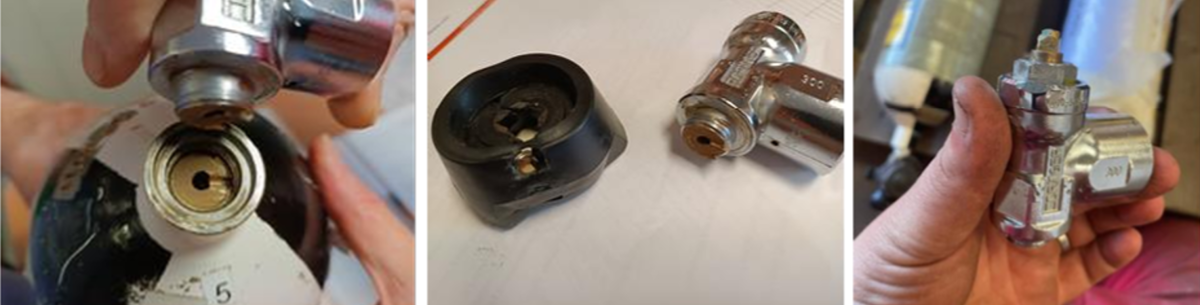
During preparations to land a leaking breathing apparatus bottle ashore, a crew member was draining the remaining pressure from the bottle when the pillar valve broke off from the top.
On inspection of the damaged valve, it was found that there was a fracture of the threaded end which had resulted in failure along a crack likely caused by metal fatigue.
The MSF notes that “although this could not have been foreseen, the potential for serious injury was very high if the bottle had been fully pressurised. In this case there were no injured persons.”
What was the cause?
The cylinder and associated fittings were sent for further investigation, and the investigator noted that there was evidence that the pillar valve had “seen a heavy impact, the nut retaining the handwheel has been pushed through the handwheel itself and …what is left of the spindle has also seen a heavy impact along with the valve itself.”
It was the opinion of the investigator that the cylinder had been dropped onto the valve causing it to break. This was considered a very serious incident that ultimately could have caused a fatality.
Actions
The MSF report notes that there was an extremely high potential for this incident to have caused harm. The vessel owner recommended the following actions:
- When moving pressurised cylinders around the vessel extreme care should be exercised.
- When decanting cylinders for transportation, the cylinder should be held securely with the valve being slightly cracked open with the contents being released in a slow and controlled manner.
- Always make sure that the valve end of the cylinder is pointing away from yourself and any colleagues.
- When conducting this operation full PPE should be worn.
- The vessel owner is investigating the fitting of Excess Flow Valves when individual cylinders pass through the maintenance workshop.
Related Safety Flashes
-
IMCA SF 20/17
11 August 2017
-
IMCA SF 01/16
7 January 2016
-
IMCA SF 12/09
17 August 2009
IMCA Safety Flashes summarise key safety matters and incidents, allowing lessons to be more easily learnt for the benefit of the entire offshore industry.
The effectiveness of the IMCA Safety Flash system depends on the industry sharing information and so avoiding repeat incidents. Incidents are classified according to IOGP's Life Saving Rules.
All information is anonymised or sanitised, as appropriate, and warnings for graphic content included where possible.
IMCA makes every effort to ensure both the accuracy and reliability of the information shared, but is not be liable for any guidance and/or recommendation and/or statement herein contained.
The information contained in this document does not fulfil or replace any individual's or Member's legal, regulatory or other duties or obligations in respect of their operations. Individuals and Members remain solely responsible for the safe, lawful and proper conduct of their operations.
Share your safety incidents with IMCA online. Sign-up to receive Safety Flashes straight to your email.