Connection failure during lifting operation
- Safety Flash
- Published on 23 November 2022
- Generated on 24 October 2026
- IMCA SF 26/22
- 3 minute read
On a windfarm installation vessel, there was a connection failure during operations.
What happened?
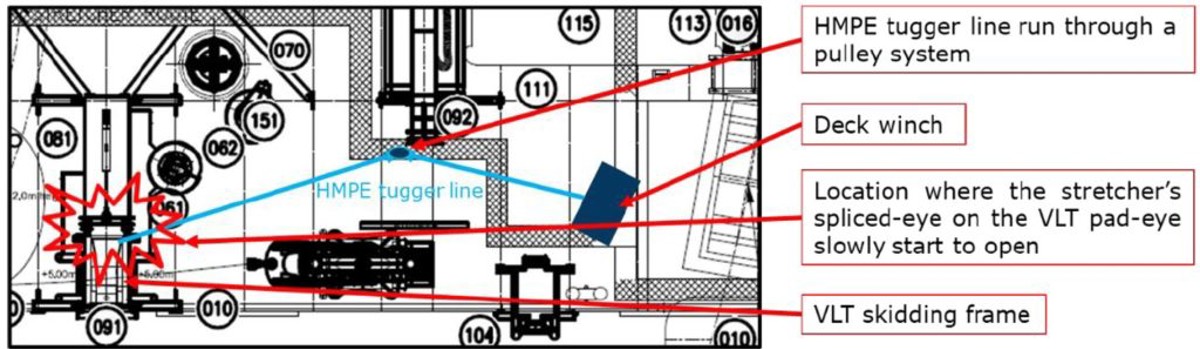
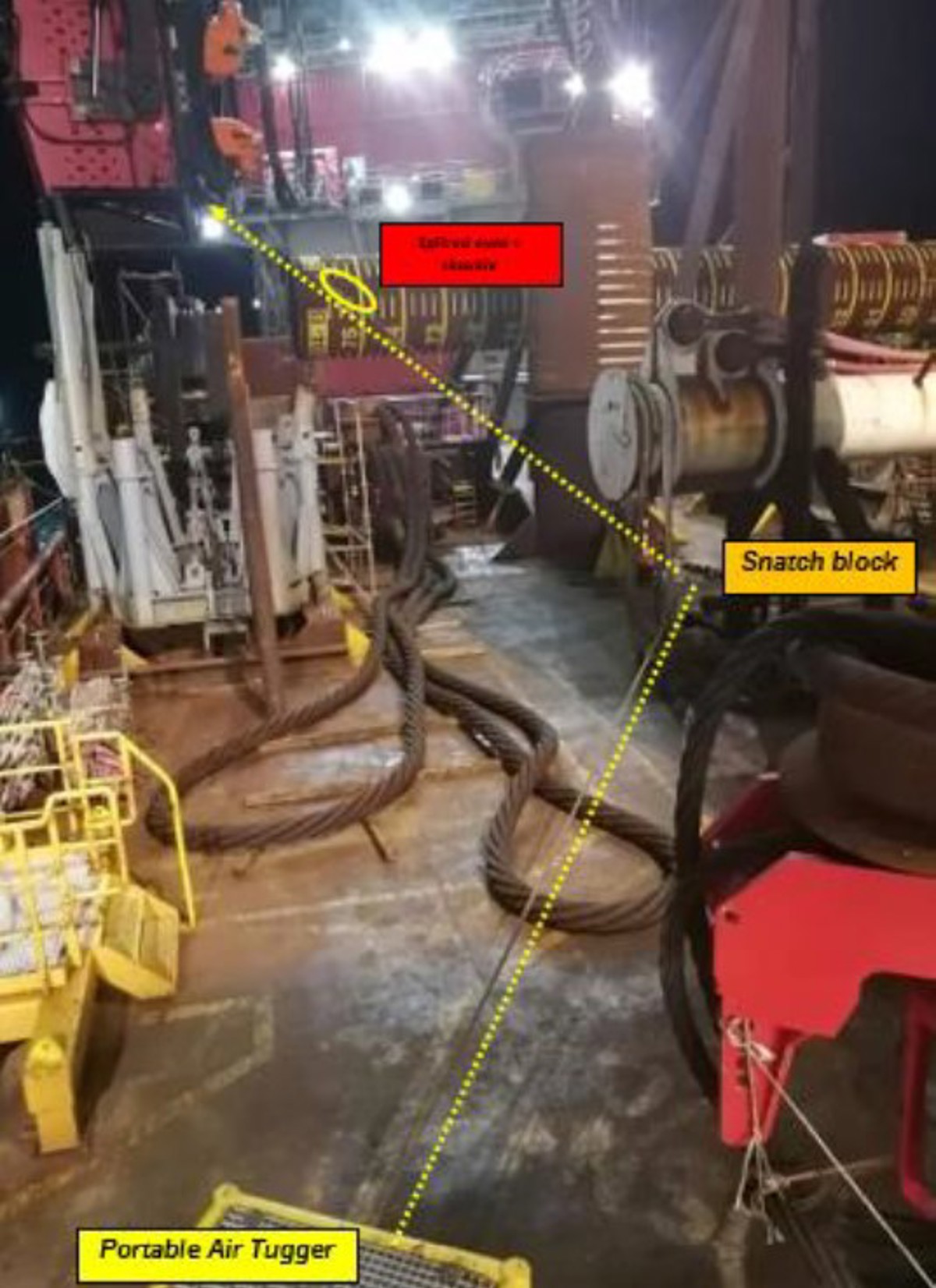
During lowering and rotating of the Vibro Lifting Tool (VLT) into the skidding frame for the pile upending process, the spliced-eye connected on the VLT pad eye slowly opened up. The tugger line sprung toward the winch with low energy and fell on the deck. There were no injuries.
To guide the equipment onto the skidding frame, a tugger line was connected to the VLT by means of a self spliced-eye. The tugger line was made of HMPE (High Modulus Polyethylene) spooled on the dedicated deck winch.
Swipe to see next image
What went right
An exclusion zone had been established and personnel involved were not in the line of fire. The Vibro Lifting Tool was already inside the guide of the skidding frame and the insertion of the VLT could be completed without consequences.
What went wrong?
The incident investigation could not identify the exact root causes, however the following causes have been considered as contributing to the event:
- Amount of force applied to the tugger line.
- The tugger line arrangements/connections weren’t engineered
- Quality of the tugger line splice:
- The spliced eyes were prepared on board by the crew.
- Written instructions from the manufacturer for a high performance splice of a 12 strand rope was available on board.
- The crew experienced in splicing could not demonstrate having received formal training.
- The quality of the splice wasn’t checked against the written instruction.
- The splice was covered with duct tape and therefore impossible to inspect and to notice any partial damage/excessive wear/fatigue.
- The spliced-eye was choked on the VLT’s pad eye without use of a shackle, resulting in a small bending radius where the fibre rope is wrapped around the edges of the pin hole and pad-eye plate increasing the risk of damage to the rope and the spliced eye.
Our member took the following actions:
- Ensured that splices are only made by competent, qualified and trained personnel.
- Ensured crew were aware that the Maximum Breaking Load (MBL) of a tugger line is reduced by applying a spliced-eye.
- Splices in general should not be covered by tape as it prevents regular visual inspection, use the original equipment manufacturer protection covers instead.
- Spliced ropes should be part of the vessel maintenance regime as per manufacturer’s instructions.
- Avoided the choking of tugger lines, using suitable shackles instead.
Related Safety Flashes
-
IMCA SF 27/19
22 November 2019
-
IMCA SF 32/17
21 December 2017
-
IMCA Safety Flashes summarise key safety matters and incidents, allowing lessons to be more easily learnt for the benefit of the entire offshore industry.
The effectiveness of the IMCA Safety Flash system depends on the industry sharing information and so avoiding repeat incidents. Incidents are classified according to IOGP's Life Saving Rules.
All information is anonymised or sanitised, as appropriate, and warnings for graphic content included where possible.
IMCA makes every effort to ensure both the accuracy and reliability of the information shared, but is not be liable for any guidance and/or recommendation and/or statement herein contained.
The information contained in this document does not fulfil or replace any individual's or Member's legal, regulatory or other duties or obligations in respect of their operations. Individuals and Members remain solely responsible for the safe, lawful and proper conduct of their operations.
Share your safety incidents with IMCA online. Sign-up to receive Safety Flashes straight to your email.