US Coast Guard: Damaged control cables can contribute to unintended opening of a hook
- Safety Flash
- Published on 28 September 2020
- Generated on 25 October 2026
- IMCA SF 28/20
- 2 minute read
The United States Coast Guard (USCG) has released Safety Alert 03-20 relating to the importance of checking the integrity of lifeboat control cabling
What happened?
The Safety Alert addresses the importance of checking for and replacing damaged control cables that operate between the release handle and hook in a lifeboat hook release system.
What were the causes? What went wrong?
The Coast Guard investigated a casualty involving the unintended on-load release of a lifeboat hook from a davit fall wire.
Prior to the incident, damage was noted to a control cable between the release handle and one of the hooks. However, the damaged cable remained in service.
The damage may have subsequently worsened over time and contributed to the unintentional release.
Members can see the full Safety Alert here.
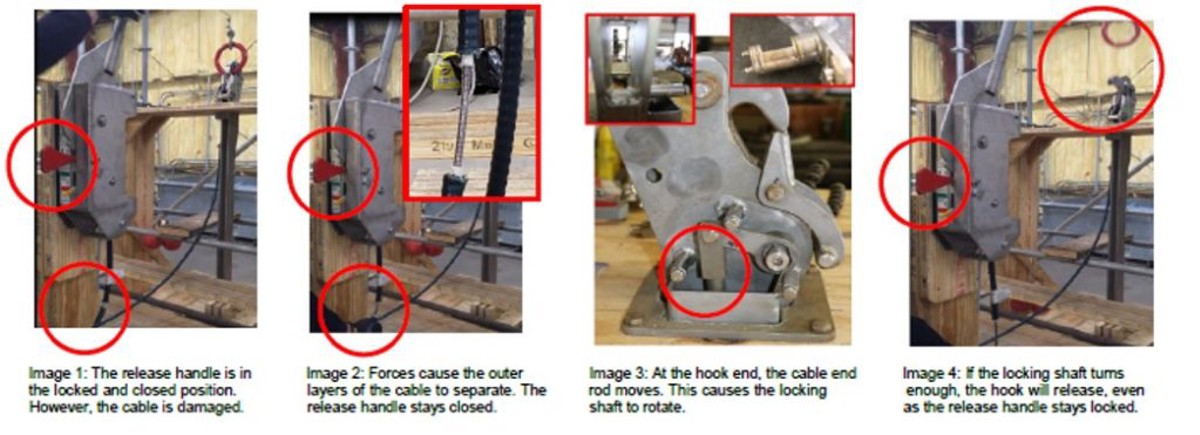
The U.S Coast Guard strongly recommends that: “lifeboat owners, manufacturers, operators and service providers:
- Conduct thorough inspections of control cables between the release handle station and release hooks, as well as any other similar cables communicating between the release station and the hydrostatic interlock, if installed, looking for current damage and for potential hazards or other conditions that might compromise the cables in the future.
- Replace cables that show signs of wear or damage to any layers.
- Implement an inspection regime that allows for cable damage to be identified and, as necessary, for cables to be replaced in a timely manner.
- Consult the lifeboat and release mechanism’s operations manual prior to conducting launch and recovery drills. It is important to remember that safety pins can be used during drills to prevent the hook-locking shaft from rotating, when they are approved as part of the release mechanism. Although safety pins may provide an extra level of safety during drills and training, operators should ensure that lifeboats are stowed in the “ready to launch” condition without safety pins in place. Ensure that lifeboat crews understand that safety pins will prevent a lifeboat from releasing from the fall wires during a real emergency if they are not removed after routine training evolutions or maintenance.
Marine inspectors, investigators, surveyors and servicing technicians are encouraged to maintain an acute awareness to these issues and initiate corrective actions as needed.”
IMCA Safety Flashes summarise key safety matters and incidents, allowing lessons to be more easily learnt for the benefit of the entire offshore industry.
The effectiveness of the IMCA Safety Flash system depends on the industry sharing information and so avoiding repeat incidents. Incidents are classified according to IOGP's Life Saving Rules.
All information is anonymised or sanitised, as appropriate, and warnings for graphic content included where possible.
IMCA makes every effort to ensure both the accuracy and reliability of the information shared, but is not be liable for any guidance and/or recommendation and/or statement herein contained.
The information contained in this document does not fulfil or replace any individual's or Member's legal, regulatory or other duties or obligations in respect of their operations. Individuals and Members remain solely responsible for the safe, lawful and proper conduct of their operations.
Share your safety incidents with IMCA online. Sign-up to receive Safety Flashes straight to your email.