Dropped object – Crane auxiliary block dropped from crane boom
- Safety Flash
- Published on 8 April 2021
- Generated on 25 October 2026
- IMCA SF 10/21
- 2 minute read
Two sub-contracted crane technicians were mobilised to the vessel to inspect the pipelay system 15Te crane before a load and rock test of the crane took place.
What happened?
Following completion of the inspection, which included a function test of all equipment and interlocks, no issues were detected and the pipelay team then began preparations for the testing utilising water weight bags.
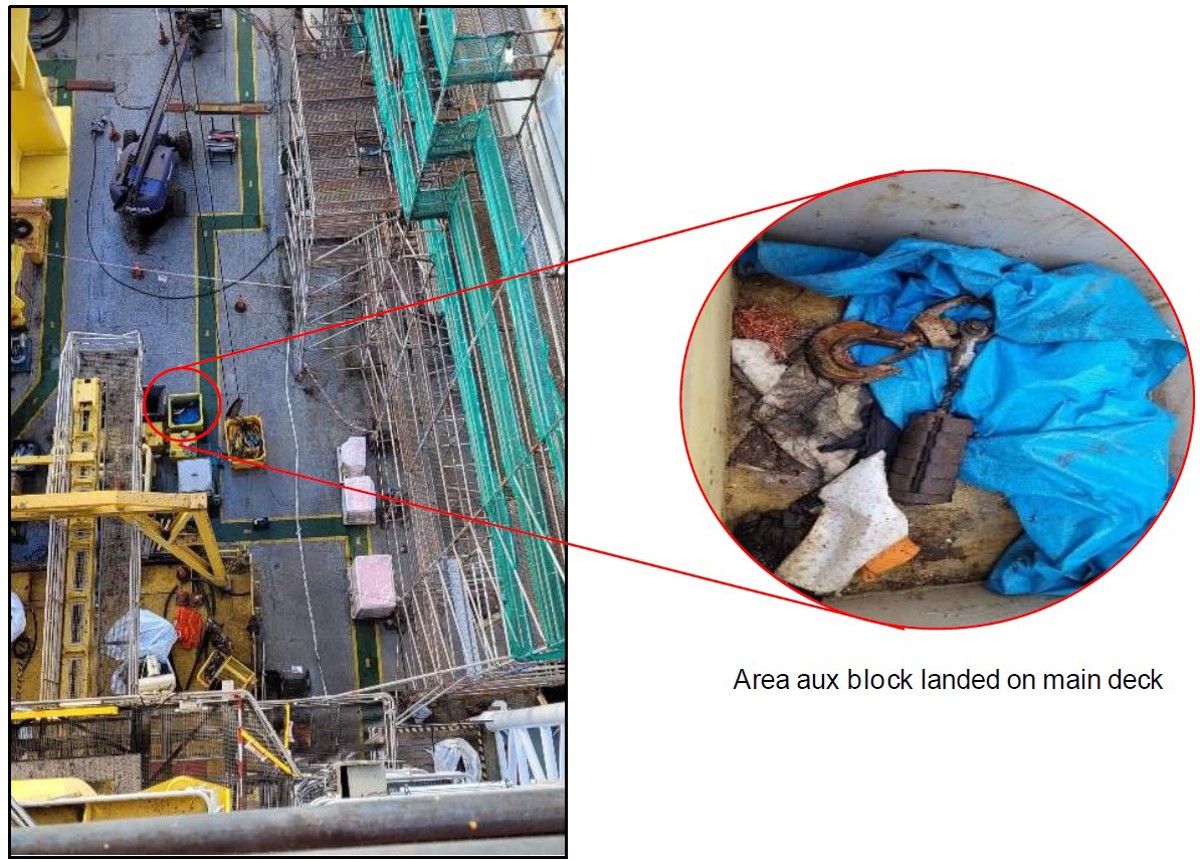
The crane operator was instructed by the banksman, who was situated on the main deck to extend the boom so it was positioned over the basket containing the water bags, sited on the main deck. It was during the extension of the boom that the auxiliary crane wire failed and the block, weighing 30 kg dropped from crane boom to main deck (approximately 30 metres). The block landed directly into a steel container that was used for storing tensioner pads.
What was the cause?
The cause of the failure was due to the double blocking of the auxiliary block and chandelier, also the interlock overload protection failed to activate.
Lessons learned and actions
This incident is currently under investigation and further information may be available at a later time.
- The following good practices were noted:
- The operation was being controlled under a Permit to Work.
- A task specific risk assessment had been developed which clearly identified potential dropped objects, the need for barriers and sentries and restricted access to the deck.
- The operation was being controlled under a Permit to Work.
- The following immediate improvement was identified:
- Although a banksman was in place for this task, he was too far away to effectively monitor the full movement of the crane. An additional spotter should have been used.
- Although a banksman was in place for this task, he was too far away to effectively monitor the full movement of the crane. An additional spotter should have been used.
- Further discussion points:
- Ensure crane checks are carried out daily.
- Ensure crane operators do not rely solely on their crane limits to stop a movement.
- The banksman should at all times direct the crane operator when the crane is on the move, from start up when removing the crane from the rest, through to until it is parked and made secure.
- Where applicable, additional spotters should be used to monitor positions of crane blocks.
- Ensure crane checks are carried out daily.
- HSS019 Guidelines for lifting operations
- Lifting operations (safety promotional video ‘Be prepared to work safely’)
- Lifting equipment (safety promotional video ‘Be prepared to work safely’)
IMCA Safety Flashes summarise key safety matters and incidents, allowing lessons to be more easily learnt for the benefit of the entire offshore industry.
The effectiveness of the IMCA Safety Flash system depends on the industry sharing information and so avoiding repeat incidents. Incidents are classified according to IOGP's Life Saving Rules.
All information is anonymised or sanitised, as appropriate, and warnings for graphic content included where possible.
IMCA makes every effort to ensure both the accuracy and reliability of the information shared, but is not be liable for any guidance and/or recommendation and/or statement herein contained.
The information contained in this document does not fulfil or replace any individual's or Member's legal, regulatory or other duties or obligations in respect of their operations. Individuals and Members remain solely responsible for the safe, lawful and proper conduct of their operations.
Share your safety incidents with IMCA online. Sign-up to receive Safety Flashes straight to your email.