Hand injuries dealing with sharp objects
- Safety Flash
- Published on 4 June 2025
- Generated on 16 October 2026
- IMCA SF 10/25
- 2 minute read
What happened?
A member reports two separate incidents relating to sharp objects.
Incident 1: A deck crew member sustained a finger injury while cutting duct tape connecting two halyards during maintenance. The cutter blade sliced through the glove, resulting in a cut that required medical attention and stitches.
Incident 2: A crew member sustained a severe hand injury while manually adjusting a package with a damaged metal rim on a pallet. The sharp rim caused a deep cut near the thumb, requiring 12 stitches to stop the bleeding.
What went wrong?
· Incident 1:
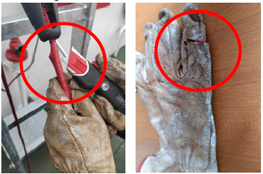
Incorrect cutting position
̶ Incorrect Hand Positioning: The crew member placed his hand directly beneath the halyard in the cutting zone rather than keeping it clear of the blade’s anticipated reach;
̶ Improper Support Method: The halyard was handheld instead of being placed securely on available surfaces such as the deck, bulwark, or bulkhead, increasing the risk of instability during the cutting process.
· Incident 2:
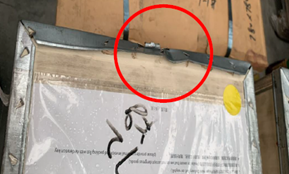
Damaged metal rim of the package
̶ Failure to wear mandatory PPE: The crew member was not wearing suitable hand gloves, which are essential to protect against sharp edges during manual tasks;
̶ Lack of Situational Awareness: Despite noticing the damaged metal rim, the crew member lost focus during the task and inadvertently placed his hand near the sharp protruding edge, leading to the injury.
What are the lessons?
· Know, understand and maintain safe hand positioning when handling sharp objects;
̶ Always grip objects to be cut with hands/fingers positioned at least 30–40 cm away from the blade’s operating area;
̶ Never place hands directly underneath or near the blade;
̶ Use a stable surfaces for cutting whenever possible;
· PPE – it is mandatory for a purpose – use it
̶ If the PPE is uncomfortable, look into obtaining a different or better kind – but it’s better to be uncomfortable than to need 12 stitches…
· Make a thorough inspection of cargo, boxes and packages for hazards. Damage during transport and storage may have caused hazards.
Related Safety Flashes
-
IMCA SF 14/21
20 May 2021
-
-
IMCA SF 25/18
9 November 2018
-
-
IMCA SF 19/21
12 July 2021
-
-
IMCA SF 28/16
18 October 2016
IMCA Safety Flashes summarise key safety matters and incidents, allowing lessons to be more easily learnt for the benefit of the entire offshore industry.
The effectiveness of the IMCA Safety Flash system depends on the industry sharing information and so avoiding repeat incidents. Incidents are classified according to IOGP's Life Saving Rules.
All information is anonymised or sanitised, as appropriate, and warnings for graphic content included where possible.
IMCA makes every effort to ensure both the accuracy and reliability of the information shared, but is not be liable for any guidance and/or recommendation and/or statement herein contained.
The information contained in this document does not fulfil or replace any individual's or Member's legal, regulatory or other duties or obligations in respect of their operations. Individuals and Members remain solely responsible for the safe, lawful and proper conduct of their operations.
Share your safety incidents with IMCA online. Sign-up to receive Safety Flashes straight to your email.